Football is Awesome. But, Sometimes the NFL Wins and Taxpayers Lose.
By Paige Battcher and Richard Green, Director, USC Lusk Center for Real Estate
National sports leagues are notorious for gaining tax dollars and subsidies. In testimony to the U.S. Senate in 1990, Richard Horrow indicated that since 1990, there have been “seventy-seven major league facility lease re-negotiations, modernizations, or newly constructed projects in professional football, baseball, basketball and hockey at an approximate cost of $12 billion” (Seaton Hall 2001; See also Stadium Financing and Franchise Relocation Act of 1999: Hearing on S. 952 Before the U.S. Senate Comm. on the Judiciary, 106th Congress).
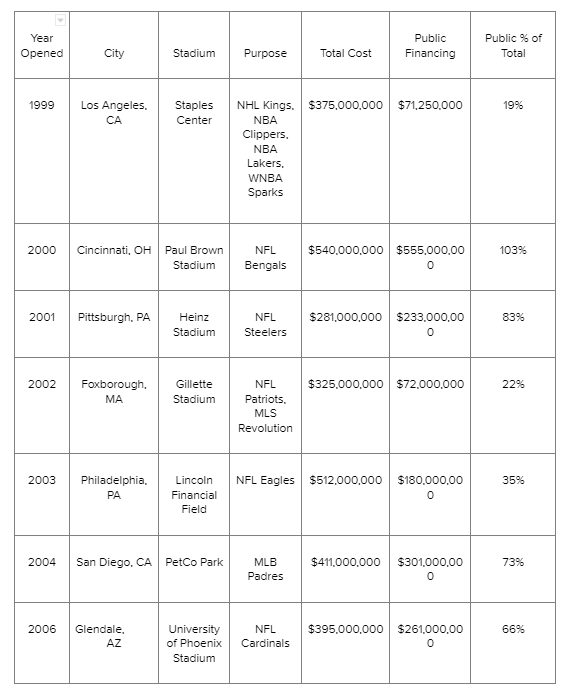
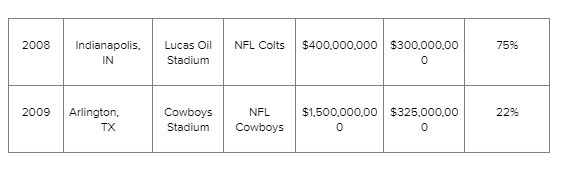
Often, when subsidizing facilities for an NFL team, the public bears too large a burden for too little reward (See also Appendix 1). Sally Jenkins with The Washington Post captured this frustration by saying: “At its best the NFL is a deeply embedded piece of American culture, with an indissoluble bond with fans. But it's grown far removed from the grass-roots recreation it started as, the competitive emblem of mill towns, and their enormous civic resilience. As fans, we share blame for being willing to pay anything for it. We've allowed league owners to cash in on American pride, and hunger for entertainment. We should insist they share American economic problems” (Jenkins 2011).
When NFL teams relocate they have a remarkable ability to do so at a cost to local taxpayers. When Art Modell, owner of the Cleveland Browns in 1994, sought taxpayer money to construct a new stadium and was turned down by the public, he went to other cities. Baltimore stepped in offering a promised package that included “rent-free use of a new $200 million stadium at Camden Yards” and “the rights to half of the revenues from all non-football events held in the stadium” (Sandomir 1996). This $200 million dollar subsidy to persuade the Cleveland Browns (now the Baltimore Ravens) to relocate was not a quantifiable economic success for the city of Baltimore –whose politicians touted jobs as the primary benefit. In fact, the Congressional Research Service concluded a statistical analysis that estimated “for every job created by the team’s move, it cost Maryland taxpayers between $127,000 to $331,000” (Seton Hall 2001). Despite the high cost, Baltimore increased their debt by subsidizing the stadium in order to serve a private sports franchise. And, the city, by increasing its debt, also increased the borrowing costs to construct needed roads and schools (Peirce 1996).
Unlike stadiums for colleges and universities, which are invested in the community for the long-term, NFL teams rarely display institutional loyalty or have authentic community interests. Their presence in a city can be fleeting. The repercussions of relocation can be plenty –including but not limited to vacant stadiums and lingering bond payments.
Sources:
Jenkins, Sally. "After a bloated Super Bowl in Dallas, it's time to rein in big game." The Washington Post, February 8, 2011.Peirce, Neil R. "Calling Time on Sports Tax Breaks." National Journal, July 20, 1996.Sandomir, Richard. "Owners' New Strategy: Take the Team and Run." New York Times, January 14, 1996: 4.Seton Hall. "The Use of the Eminent Domain Power
in the Relocation of Sports Stadiums to Urban Areas: Is the Public Purpose
Requirement Satisfied?" Seton Hall Journal of Sport Law, 2001: 137-149.
Appendix 1